

Editor’s note: Charles Krauthammer’s posthumous book of selected columns, essays, and public addresses became a New York Times bestseller shortly after its publication in late 2018. Commentators, peers, and literary reviewers praised it as an essential, profound, and beautifully crafted testament to one of the preeminent political and cultural thinkers of our time. By then I had been reading Krauthammer’s columns for 30 years — and heartily agreed.
In keeping with my habit of revisiting beloved books every seven years or so, I decided to read it this past summer. Midway through, I was asked by RJC Executive Director and JPC CEO Matt Brooks to step in as interim editor for inFOCUS after JPC’s longtime senior leader Shoshana Bryen had stepped back from her work and into a hospital for care. I finished the book the same week the final chapter of Shoshana’s life came to a close. I have since learned that her death was a shock to many who knew her, and as I read all the heartfelt remembrances, I came to regret that I didn’t know her.
I felt the same way about Charles Krauthammer when he passed into the Hereafter — and felt it again upon rereading his tremendous body of work in this month’s IF-featured book. For those who knew Shoshana, Charles, or both: How marvelously blessed you were! The rest of us have “only” their work by which to love and remember them. It is a testament to their remarkable lives and unquenchable spirits that to have that is a very great thing, indeed.
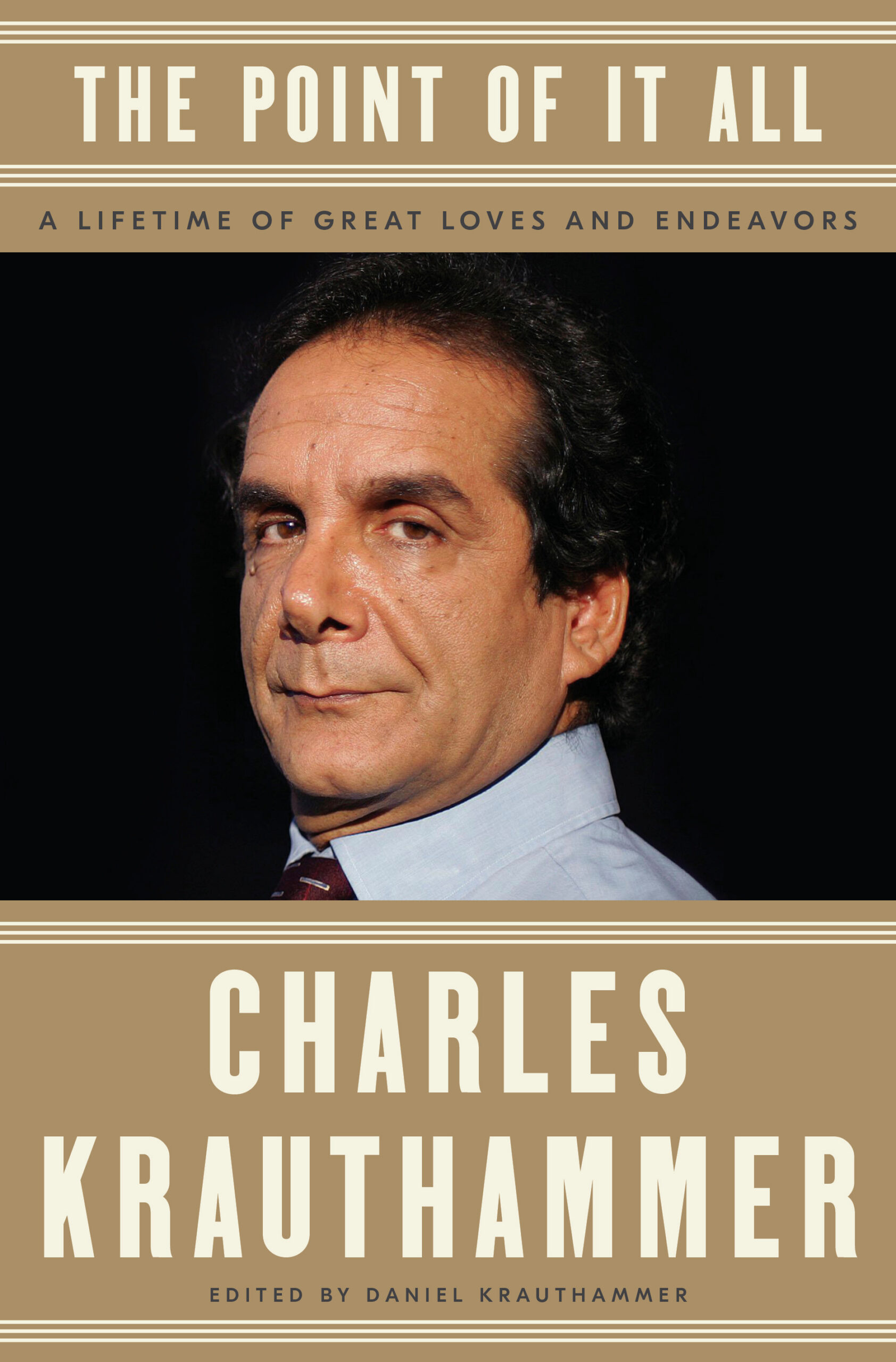 The collected works in The Point of It All offer readers what Charles Krauthammer consistently delivered in nearly four decades of essays, speeches, and syndicated weekly columns for the Washington Post: knowledge, intelligence, insight, thoughtfulness, and wit. The word most frequently exclaimed by this humble reader at the end of a particularly poignant CK piece: “Brilliant!” To miss this book is to miss a treasure trove of truth-telling and inspired writing.
The collection was conceived and loosely assembled in an Emory University Hospital room by the author and his only child, Daniel, then 32 years of age, who lovingly finished it after Charles died in 2018. The articles are not in chronological order. They move from topic to topic, decade to decade, anchored by the author’s distinct approach to a sustained inquiry into the American condition.
What defines the book is what defined everything Charles wrote and said: keen observation, cogent connections, elegant phrasing, fearless honesty, and a humble humanity — rolled out in a cadence that has you in its thrall before the second turn around the dance floor. He leads deftly. The reader trusts, and glides along. Even his sarcasm is soft, subtle. No sting, only pointedness. The truth — delivered with grace.
For those who don’t know his work, Krauthammer’s reputation was as an independent thinker. Though he frequently served as a staunch conservative voice, he sometimes challenged strict party lines or took nuanced positions on divisive topics, including parental rights in extreme medical cases, assisted suicide, and the morality of the death penalty. I had been reading Krauthammer’s work for years before learning why his writing on medical issues was so thoughtful, and at times, unexpected. Before turning to writing, Krauthammer had been a physician and psychiatrist.
He graduated from Harvard Medical School in 1975 — completing his studies on time despite a diving board accident during his first year that left him permanently paralyzed from the waist down, paired with a wheelchair for life. He went on to serve as the chief resident in psychiatry at Massachusetts General Hospital and was involved in planning and creating a book that fundamentally reshaped how modern psychiatric conditions are classified—the third edition of the Diagnostic and Statistical Manual of Mental Disorders. He then relocated to Washington, D.C., where he directed psychiatric research planning for the Carter administration. By 1980, he had exited psychiatry and pivoted into political discourse. He was a presidential speechwriter for Vice President Walter Mondale before formally launching his 37-year journalism career at The New Republic in 1981.
The reader will find his political commentary is rooted in a firm thesis on the proper purpose of the federal government: preserve individual dignity and liberty, protect life and property, defend the homeland and its allies, and otherwise let people be. His foreign policy essays are rooted in conservative realism, including his long-form essay on the challenge modern populism poses to liberal institutions worldwide. His lighter pieces are on love and loss in baseball, the worthiness of sustained space exploration, and his quick shift (after suffering under the intense pressures of a formal competitive event) into speed chess.
The principles and ideals in the collection remain profoundly relevant. For many readers, it will work best as a volume to sample slowly. A column a day will keep you on your mental toes; two or three will fill your dance card nicely. Others may wish to listen to the book on Audible, read by stage, film, and television actor Jeremy Bobb (The Knick, The Outsider, Russian Doll). As a bonus, Daniel Krauthammer narrates his own foreword and the book’s final entry: the deeply loving, poignant eulogy he delivered for his beloved father, whom he rightly described as one of the greatest minds of the modern age. Be sure to have a box of tissues handy.
Elizabeth Thompson is the interim editor of inFOCUS Quarterly and previously served as the editor-in-chief at The Nevada Independent.
