

“I know of no way of judging the future but by the past,” Patrick Henry asserted in advocating independence from a consistently oppressive Great Britain. But when it comes to elections, the more the present electorate diverges from past electorates, the less reliable past election results may be as a guide.
With that in mind, consider how today’s public differs from that of the not-too-distant past and from the intentions and expectations of America’s Founders. Start with attitudes about the connection between religion and good government, and end with attitudes toward Jews and Israel. The two are related.
Religion and Government
Recognizing the often-uncontrolled passions of human beings, President John Adams wrote in a 1798 letter to the Massachusetts Militia, “Our Constitution was made only for a moral and religious people. It is wholly inadequate to the government of any other.”
Eleven years earlier, before the Constitution had been written, the Confederation Congress adopted the Northwest Ordinance. The legislation established the government and means of acquiring statehood for the territories that would become Ohio, Indiana, Illinois, Michigan and Wisconsin. The first sentence of Article Three, still etched into the campus gate of Ohio University, established in 1804 as the first institution of higher learning west of the Allegheny Mountains, reads:
“Religion, morality, and knowledge, being necessary to good government and the happiness of mankind, schools and the means of education shall forever be encouraged.”
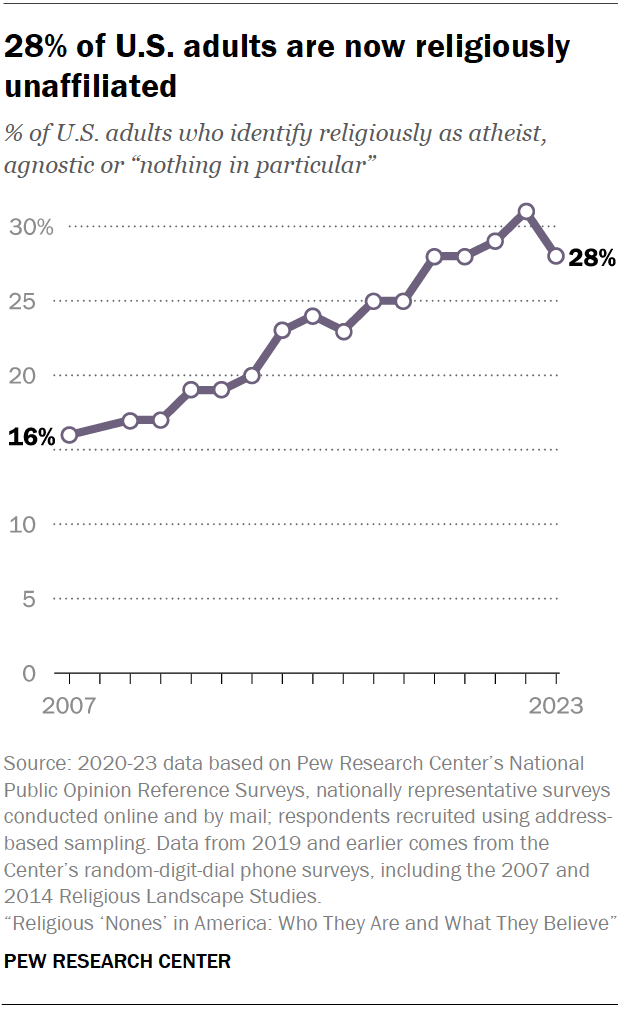
The Founders notwithstanding, Americans’ views on the importance of religion appear to be declining. A Pew Research exit poll after the presidential election of 2008, in which then-Sen. Barack Obama (D-IL) defeated Sen. John McCain (R-AZ), put religiously unaffiliated voters at 12 percent, up from 9 percent in 2000. In the 2024 contest between presidents Joe Biden and Donald Trump, Pew found that religiously unaffiliated voters made up 28 percent of the electorate.
This category, “nones” to pollsters, includes 17 percent atheists, 20 percent agnostics, and 63 percent who described their religious affiliation as “nothing in particular.” According to Pew, “nones [excepting atheists and agnostics] tend to vote less often, do less volunteer work in their communities and follow public affairs at lower rates than religiously affiliated people do.”
As for party affiliation, a 2024 Pew survey indicated that “religious ‘nones’ have become more Democratic over the past few decades as their size in the US population overall and in the electorate has grown significantly. While 70 percent of religiously unaffiliated voters align with the Democratic Party, just 27 percent identify as Republicans or lean Republican.”
Meanwhile, 85 percent of white evangelical voters identify with or lean toward the Republican Party; “just 14 percent align with the Democrats.” Pew estimates that there are roughly 78 million adults who identify as evangelical Protestants and/or “born-again Christians,” or 23 percent of the total. But “nones,” at 28 percent or 101 million adults, now appear to be the largest “religious affiliation” category among Americans and the only one growing in percentage and absolute terms.
Of course, an agnostic, atheist, or religiously unaffiliated individual can live a life of moral rectitude and informed political activity. But can entire societies, in particular Western democratic-capitalist ones whose laws are rooted in Judeo-Christian ethics? And if so, for how many generations, given that Americans who today’s pollsters classify as “nones” acquired their moral-ethical beliefs in societies that taught those beliefs as religiously based?
Cashing Out on Capitalism?
Capitalism’s prophet, Adam Smith, recognized free markets as necessary for “natural liberty.” But a significant portion of today’s electorate appears to doubt this cornerstone of history’s greatest engine of economic growth.
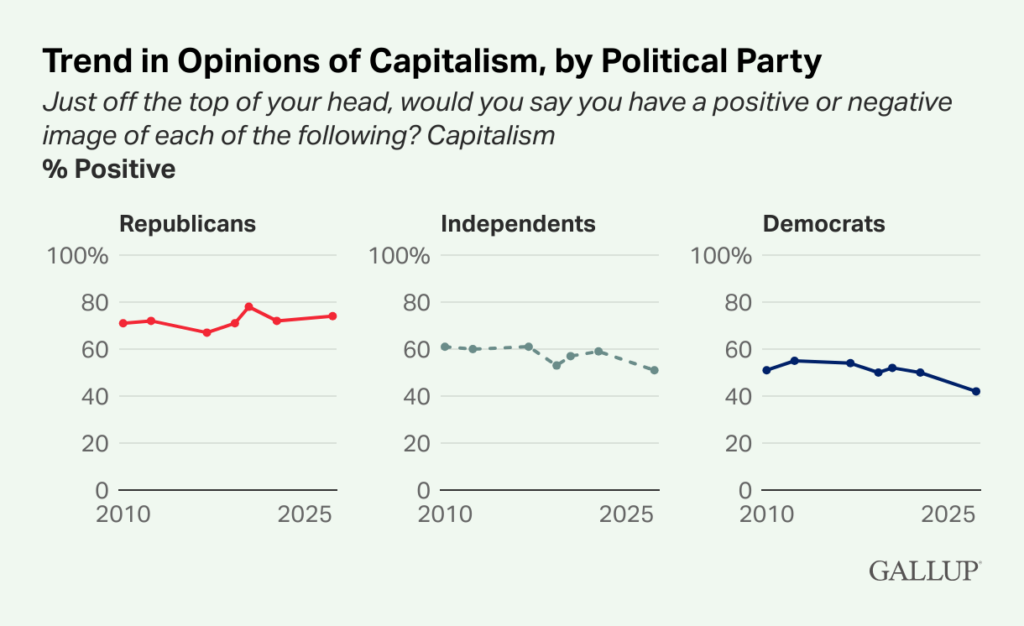
In September 2025, a Gallup poll found that support for capitalism had dropped from 60 percent in 2021 to 54 percent. Perhaps reflecting broader public polarization, Republicans held relatively steady, with roughly three-fourths of GOP supporters approving, while Democrats and independents each dropped eight percentage points from 2021 to a minority of 42 percent among Democrats and 51 percent among independents.
Tucked within that general snapshot was a detail of potential importance to conservatives as well as liberals. “Americans are overwhelmingly positive toward small business (95 percent) and free enterprise (81 percent), as they have consistently been. They are far more negative toward big business, with 37 percent rating it positively and 62 percent negatively.” General public backing for socialism stands at 39 percent today, up four points in 10 years.
Hostility to certain large corporate activities appeared in a March 2026 Gallup public opinion poll. Seventy-one percent of respondents said they either strongly (48 percent) or somewhat strongly (23 percent) opposed the construction of nearby data centers, which can require large amounts of electricity, water and land to power artificial intelligence operations by firms including Google, Microsoft and Amazon. This compared to 53 percent opposed to building a nuclear power plant nearby.
Overall, a July 2026 Wall Street Journal-National Opinion Research Center (NORC) survey found “just under half of Americans say capitalism is working very well or even somewhat well.” This marked a drop from 60 percent a decade earlier.
Among the youngest voters, hostility to the influence of large corporations may translate, paradoxically, into expectations for help on “affordability” issues from bigger government and sympathy for socialism. In a recent Wall Street Journal commentary, Emil Barr, the 23-year-old founder of one tech-related company and co-founder of a second, wrote that “53 percent of self-identified conservatives under 40 support government-run grocery stores. Not Democrats, conservatives. Take that in.”
One of Barr’s companies tracks layoffs caused by artificial intelligence, “and every month I look at spreadsheets that show my generation losing entry-level jobs faster than anyone anticipated. So, when the polling says young Americans have soured on capitalism, I’m not surprised by the anger.”
The left directs that economic anger at billionaires and big business, Barr says. The right gets to the same antipathy by targeting “China, immigrants, Israel or whichever group is being blamed that month for why we can’t afford what our parents could at our age.”
Over-schooled but under-educated younger voters may not be able to distinguish Adam Smith from early Jamestown’s Captain John Smith, but the causes for their economic grievances appear to extend beyond fear of AI-caused employment losses.
Add income stratification and, for the 80 percent of the public below the upper middle class, stagnant inflation-adjusted wages. Another Wall Street Journal columnist, Allysia Finley, says this means that since 2021 the typical worker’s earnings “have been flat. His real take-home pay, after taxes and other deductions, has fallen.” Hence the affordability crisis, which is fueling the rise of the Democratic Socialists of America and giving those who scoff at “the American dream”—or redefine it as government-provided—a potent campaign issue.
American Dreaming
According to The Journal-NORC poll, “only 35 percent are even fairly sure that the nation offers people the ability to get good jobs and achieve the American dream.” In 2012, 53 percent believed “the American dream—if you work hard you’ll get ahead—still holds true.”
If so, then giving voice to the original meaning of “the American dream” might prove critical. James Truslow Adams, winner of the 1922 Pulitzer Prize for The Founding of New England, defined it as “that dream of a land in which life should be better and richer and fuller for everyone, with opportunity for each according to ability or achievement. … It is not a dream of motor cars and high wages merely, but a dream of social order in which each man and each woman shall be able to attain to the fullest stature of which they are innately capable, and be recognized by others for what they are, regardless of the fortuitous circumstance of birth or position.”
That is, a social order of “free minds, free speech, free markets and free people” in which government exists to secure individual rights and a large, competitive private sector, not serve as chief administrator of economic activity. But according to pollsters, our changing electorate finds this social order a harder sell than it used to be.
In addition to feeling less religious and more dubious about capitalism than it used to, the US electorate reports feeling less patriotic, as well. The Wall Street Journal-NORC survey cited above found that less than 40 percent said it was proud of American history. “Two-thirds of Republicans said they were very proud of American history,” but this was “three times the share of Democrats who said so.”
As to the future of the United States, slightly more than “two-thirds of Americans say the nation that invented the airplane and the Internet, and that led the Allies to victory in World War II, is now in decline. … [M]ajorities of Republicans agreed with large shares of Democrats and independents.”
But two-thirds of Republicans still subscribe to American exceptionalism. This is the belief that history’s longest-running, most successful experiment in self-government, which annually attracts several million immigrants, legal and illegal, from around the world, stands above other nations. In contrast, only 13 percent of independents and eight percent of Democrats embraced American exceptionalism.
Free Speech Against Jews
The United States’ historic commitment to free speech helped undergird its exceptionalism. The First Amendment to the Constitution, adopted in 1791 as part of the Bill of Rights, reads: “Congress shall make no law respecting an establishment of religion, or prohibiting the free exercise thereof, or abridging the freedom of speech, or of the press; or the right of the people peaceably to assemble, and to petition the Government for a redress of grievances.”
Nevertheless, public support for free speech long has been ambivalent. In the abstract, nearly everyone is for it. But when it comes to particulars, not so much, according to Vanderbilt University researchers.
In 1939, 86 percent of respondents told pollsters democracy without freedom of speech was impossible. In 2024, 90 percent said so. However, asked whether “anybody should be allowed to speak on any subject anytime they want to, or do you think there are times when free speech should be prohibited or certain subjects or speakers prohibited?” support for “prohibit some” was 47 percent in 1939, and 41 percent in 2024. Once categories of speech have been deemed “controversial,” the “prohibit some speech” crowd can dominate, as conservatives and Zionists have found on campus.
The younger the respondent, the less likely he or she is to support free speech that might offend members of minority groups. Last year, The Future of Free Speech found that “only 47 percent of those ages 18 to 34 said such speech should be allowed, compared with 70 percent of those over 55. Similarly, tolerance for religiously offensive speech was 57 percent among younger respondents, down from 71 in 2021.”
In 2024, the Foundation for Individual Rights and Expression (FIRE), citing a Pew report, said 70 percent of college students “supported disinviting speakers perceived as bigoted.” More than “a quarter said violence could be acceptable to stop campus speech in some cases.”
And it is here that attitudes toward free speech, and perhaps other traditional values including support for religious affiliation, capitalism and patriotism may intersect with resurgent Jew-hatred. If, in the lexicon of the anti-Zionist, antisemitic post-liberal left, American Jews are not members of an oppressed or oppressible minority group but “white adjacent,” speech based on and/or promoting hostility to Jews can be tolerated. Pro-Israel and pro-Jewish speakers, by definition members of the “oppressor” class in the neo-Marxist “oppressor/oppressed” binary, should then be disinvited, their speech canceled. If such speakers show up anyway, they can be silenced violently.
Such attitudes were already plain nearly a decade ago in the embrace of antisemites by leaders of the national Women’s March. They manifested themselves on college campuses after the Oct. 7, 2023 Hamas-led massacres and kidnappings in Israel with numerous “pro-Palestinian”—actually anti-Israel, anti-Jewish—encampments and repeated harassment of Jewish students and pro-Israel speakers.
Last year, after the firebombing of the governor’s mansion on the first night of Passover while Gov. Josh Shapiro (D-PA) and his family slept inside, the murder of two Israeli embassy staffers in Washington, D.C. and attack against pro-Israel demonstrators in Colorado that killed one, the Anti-Defamation League surveyed Americans’ attitudes toward Jews. It found “34 percent believe Jewish Americans are more loyal to Israel than to the United States; 30 percent say Jews have too much influence in politics and media” and “27 percent believe Jewish Americans should answer for the actions of Israel.” The percentages increase as the age of respondents decreases.
Before his New York City mayoral campaign, Zohran Mamdani “used Zionist as a casual slur,” the Wall Street Journal has editorialized. His Democratic Socialists of America, founded in 1982 as a 6,000-member, pro-Israel socialist movement, grew in numbers and influence after adopting anti-Zionist antisemitism. It now reportedly has 150,000 members and in July called for defunding the Defense Department, abolishing police, eliminating the US Senate and subordinating the president and Supreme Court to the House of Representatives. That is, DSA seeks to overturn the Founders’ separation of powers designed to prevent authoritarian rule. Nevertheless, some Democratic Party leaders say the movement should be welcomed into their “big tent.”
Meanwhile, a February Gallup poll showed more Americans favor Palestinian Arabs than Israel. An April Pew survey indicated 60 percent viewed the Jewish state unfavorably, up 18 points in four years. Majorities of those under age 50 in both parties see Israel negatively.
German novelist Thomas Mann won the 1929 Nobel Prize for Literature. In exile in 1940, he told NBC News that “antisemitism is like a hand grenade tossed over the wall to work havoc and confusion in the camp of democracy. That is its real and main purpose.”
Asked in 1787 what kind of government the Constitutional Convention had constructed, Benjamin Franklin famously responded, “a republic, if you can keep it.” In each generation the keepers change, and with them the American republic’s odds of survival.
Eric Rozenman is a former communications consultant for the Jewish Policy Center. He is author, most recently, of The David Discovery, A Novel of the Near Future.
