

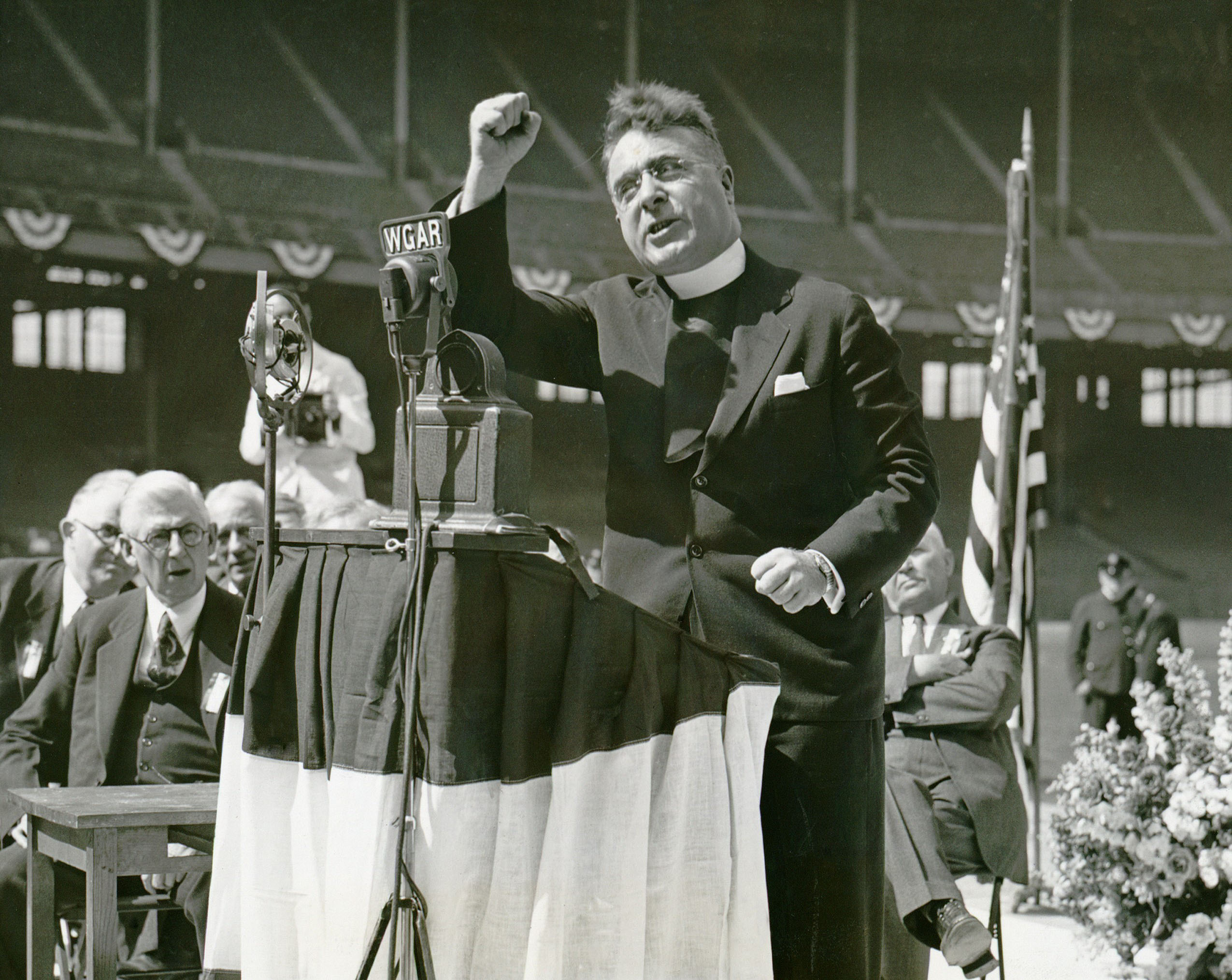
In the 1930s, Father Charles Coughlin had one of the largest radio audiences in America. He used his platform to spread divisive populist ideas, railing against the wealthy and political elites, claiming to represent “the people.” Similar rhetoric is plentiful today from online podcasters and even elected officials. From the beginning, Coughlin’s populist rhetoric also was infused with antisemitism, culminating in a 1938 broadcast on Kristallnacht in which he told his listeners that Jews had murdered millions of Christians and stolen billions of dollars in Christian property.
Back then, gatekeepers held the reins to the airwaves and information technology. The invention of radio had allowed new, often populist, voices to gain an audience, but radio syndicators and the federal government regulated what could be aired. Following Coughlin’s infamous Kristallnacht rant, radio stations refused to air his program without first reviewing his scripts. A year later, the Code Committee of the National Association of Broadcasters — speaking for 428 member stations who did not want trouble with the Federal Communications Commission — adopted a new rule that banned member stations from selling airtime to speakers who focused on controversial political issues without advance review. This spelled the end of Coughlin’s radio career. By late 1940, only two major stations still aired his show. Catholic church leaders demanded that he be stopped from broadcasting altogether, and the FBI raided Coughlin’s church, accusing him of circulating “enemy propaganda.”
Those guardrails no longer hold in today’s media environment. Social media companies are protected under Section 230 as “platforms,” not liable for third-party content on their websites. The nature of information technology itself also has changed. Broadcast licenses were once scarce and required federal approval. Today, anyone can open a TikTok or X account. There is no license to revoke for a podcast, no equal-time requirement for a Substack, and no trade association governing algorithms. Polarizing populist and antisemitic rhetoric thrives in this environment. Figures including Tucker Carlson have amassed millions of followers, and socialist Democrats have leveraged social media to spread their messages to larger audiences and win elections. The popularity of these online media figures poses a threat to America’s liberal democratic norms. The most toxic among them eschew core principles like pluralism and tolerance, while promoting hate and distrust of the “other” — which often are Jewish.
What is Populism?
The word “populism” is often misused by commentators and political candidates. The record is rarely corrected because the term is difficult to define. A frequently cited description comes from Dutch political scientist Cas Mudde, who describes populism as a “thin-centered” ideology that divides societies into two homogeneous groups that are definitionally in conflict. It establishes a “pure” common people versus a “corrupt” elite, and holds that politics should express the volonté générale, or general will of the people (Cas Mudde, “The Populist Zeitgeist,” 2004).
From there, populism and its adherents offer no coherent ideology, no solutions, and no platform. It must instead latch onto existing ideologies — socialism, communism, conservatism, etc. It is more rhetorical than policy-oriented, making it difficult to capture in traditional understandings of political philosophy. Populism is a vehicle rather than its own program. The divisions it draws are moral rather than economic. The “elite” are not merely wealthier than “the people”; they are also corrupt. It is through this lens that many of the rhetorical and political tensions we see around US economic policy can be understood.
Some say the rise in populism is due to worsening economic conditions and increasing economic inequality. Recent Pew Research surveys suggest that less than a quarter of Americans describe economic conditions as “excellent” or “good.” The decline in positive perceptions of the economy persists despite numerous positive economic indicators, including a relatively strong labor market (Bureau of Labor Statistics, 2026) and notable reductions in wage inequality (Autor, Dube, and McGrew, 2024). In this landscape, we see a broader, explanatory phenomenon. Social media, optimized with recommendation algorithms to maximize engagement and outrage, has an outsized impact on how Americans think about politics and the economy; the medium of social media is primed for populist messaging and hostile to nuance.
Populists in American Media History
Paul Matzko’s The Radio Right (Oxford University Press, 2020) reveals a rich history of populist rhetoric following innovations in information technology. Coughlin relied on the newly invented radio broadcast to air his views before federal regulators started to monitor and limit content and radio syndicates became too risk-averse for controversial political content. Following the development and popularization of television in the 1950s, broadcasters shifted investment from radio to TV shows. This left a void in the radio broadcasting space, creating room for independent, typically conservative, voices to spring up. Broadcasters such as Carl McIntire and Billy James Hargis capitalized on the “Wild West” of radio to criticize the Kennedy administration.
But these shifts were short-lived as the relatively still concentrated world of radio syndicates was more easily regulated by the federal government. Starting in 1963, following the strategy recommended by the Reuther Memorandum, the Kennedy administration directed the Internal Revenue Service (IRS) to audit radio broadcasters, and the FCC used the Fairness Doctrine against stations running right-wing shows. The Fairness Doctrine required a station airing one side of a controversial political issue to give free response time to the other side, but for cash-strapped radio shows, this was too expensive. Right-wing broadcasters lost hundreds of stations and millions of listeners. The movement was finished by the early 1970s, and did not start to recover until broadcasting deregulation under President Carter and President Reagan.
Today, insurgent populist voices similarly use new media technologies to spread their messages. However, the institutions that suppressed populist rhetoric in previous decades are weak — and overwhelmed by the amount of content that resists regulation. Following the January 6 attacks on the US Capitol, Tucker Carlson used his Fox News show to promote the conspiracy theory that the attacks were actually provoked by federal agents and not organic. Days after Fox settled Dominion Voting Systems’ defamation suit for $787.5 million — a case in which Carlson figured prominently — Fox News abruptly canceled his show. In a previous era, this likely would have ended Carlson’s public career, but in today’s media environment, even the most widely criticized figures can find an audience online. After his departure from Fox, Carlson started his own online show where he continues to express extreme and conspiratorial views, including claims that Israel manipulates US foreign policy.
In today’s media environment, Fox cutting Carlson is not career-ending; it’s a career boost. His online show has amassed a significant following, averaging 1.7 million views per episode across YouTube, Rumble and podcast feeds, according to Podscribe data cited by the Anti-Defamation League. Today, when one account is deleted, or a show is canceled, a new one appears on a different platform. Content moderation by social media platforms is insufficient to suppress populist political rhetoric.
The Public Has Options
The failure of content moderation is a symptom of a larger sea change in information technology. This shift is best explained by Martin Gurri, who spent 28 years reading the world’s newspapers and broadcasts as a CIA media analyst, and watched the flow of information reverse. In his 2014 book The Revolt of the Public, he argues that the twentieth-century arrangement where elites exercised top-down control over information has ended.
Before the introduction of user-generated content that now dominates our media diets, figures like Walter Cronkite were the sole source of news for many Americans. Government agencies, newspapers, universities, and corporations were the only parties that could see the whole picture and disseminate knowledge to the public. But when the public gains access to the same communication technologies — videos that reach millions, podcasts that go viral — the seams in the elite narratives become more apparent. The authority these institutions once held has eroded, and the public has options. They can choose new authoritative voices, when once they were limited to the same few news outlets.
This dynamic is what underlies populism, the “vibecession” that defines our political era (Scanlon, 2022). The public isn’t objectively evaluating the labor market or actual economic conditions when they report negative views of the economy; they are assessing the institutions that measure, report, and endeavor to manage the economy, and they have lost confidence in all of them. Confidence and sentiment detach from the traditional indicators because the indicators come from messengers the public no longer trusts.
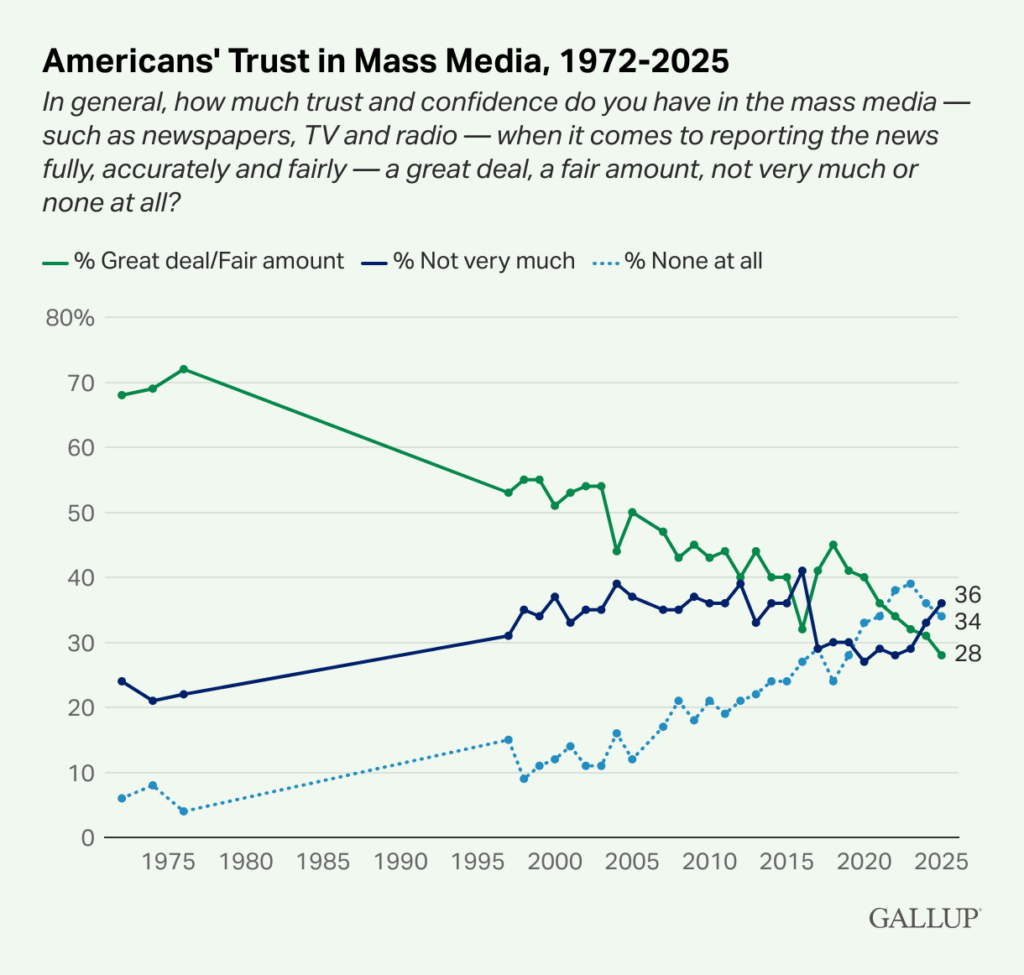
Polling bears this out. Gallup’s 2025 survey found that trust in the mass media to report the news “fully, accurately, and fairly” is at a record low — 28 percent. That same year, Pew Research Center found that 38 percent of adults under 30 get news from social media “news influencers,” and they trust these influencers about as much as traditional news organizations. For young Americans, there is not even a distinction between institutions and an individual who simply has a following. It is not just a drop in trust; it’s the disappearance of the category that created “authority” in the first place.
Why Populists Rule Our Feed
This new media environment does not just permit populism to thrive; it actively selects for it. The populists emphasize an us-versus-them tension. Conspiratorial anti-elite rhetoric is primed for the low-context, short-form content that dominates social media. Platforms are tuned to reward conflict and engagement, so they reward creators (and politicians) whose entire message is intended to ramp up conflict. This is compounded by declining trust in institutions. An establishment politician’s credentials and endorsements are presented by an entity which has already lost the public’s trust. The populist firebrand can turn this establishment disapproval into proof of their own authenticity.
Research from the University of Copenhagen (2026) analyzed almost 48,000 TikTok videos from the 2025 German federal campaigns. The researchers found that the insurgent, right-wing populist party, Alternative für Deutschland (AfD), dominated hashtag rankings, while some established parties, such as the Greens, were nearly absent from the app. On election day in 2025, AfD’s hashtag was used almost three times more than the second most mentioned party. As of September 2026, AfD has won regional elections within Germany, indicating how successful this strategy can be.
In the US, we see similar dynamics playing out. Abdul El-Sayed, the Democratic nominee in the Michigan Senate contest, has been building an online audience for himself since his failed 2018 governor’s race, starting a podcast, publishing a book, and starting a YouTube channel. He launched his Senate campaign in April 2025 with a staff of four, running on a progressive left-wing platform and rallying against corporate money in politics, which he’s framed as a movement of the “many” against the wealthy — a distinctly populist message. He’s also maintained a close relationship with a populist leftist streamer, Hasan Piker, who has repeatedly minimized the rape and sexualized torture perpetrated by Hamas during the October 7 attacks.
Establishment Democrats threw everything they could at him to try to defeat him during the primary. El-Sayed faced nearly $65 million in outside spending, much of it from AIPAC-aligned groups backing Representative Haley Stevens. Stevens received endorsements from well-known mainstream Democrats, including Gov. Gretchen Whitmer, Sen. Chuck Schumer, and Nancy Pelosi. None of these attempts to use traditional party authorities succeeded, and El-Sayed won the primary. Whatever the defects of Stevens’ campaign, it’s undeniable that El-Sayed successfully leveraged new media to spread a populist message and generate public support in a way establishment money and figures could not.
No Easy Solutions
Populism generates dangerous “us” versus “them” rhetoric, as is often used with antisemitism, and social media is uniquely successful at spreading these messages. Father Coughlin’s rhetoric wasn’t contained to just radio; it inspired antisemitic street violence. Today, we see dangerous populist rhetoric online and on our screens. It has helped fuel attacks on Jewish students at universities and Jewish-Americans in general; it has coarsened the climate in which Charlie Kirk was assassinated; and it drove the storming of the US Capitol.
It’s tempting to find the “switch” to shut it all off. To find a government policy or an individual company that should be held responsible for stopping this whole mess and returning us to more responsible politics. That instinct is honorable, but it is ultimately doomed. The nature of the internet has changed the game. The amount of content is far too great for a handful of institutions to quell populist rhetoric. Additionally, 20th century approaches often skirted the line of encroaching on First Amendment rights.
Instead, non-populists, those who respect American institutions and want to see a return to a more rational politics, must adjust to the new media environment. Rationality must win the argument again, albeit on a far more hostile terrain.
Eli Adler is an analyst and writer based in Washington, DC. Find his work online at https://elijahadler.substack.com.
