

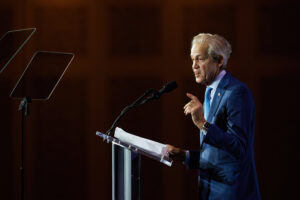
Sen. Norm Coleman is National Chairman of the Republican Jewish Coalition (RJC) and senior counsel at Hogan Lovells. He serves as vice chair of the Defense Policy Board, which advises the secretary of defense and senior Pentagon officials. He represented Minnesota in the US Senate from 2003 to 2009 and remains the last Republican the state has elected to the chamber. Sen. Coleman chaired the Senate’s Foreign Relations Committee’s Western Hemisphere subcommittee and served as ranking member of its Near East subcommittee. Earlier in his career, he worked in Minnesota’s Attorney General’s office and served as mayor of St. Paul. inFOCUS interim editor Elizabeth Thompson spoke with him in early September.
Honoring Sen. Lindsey Graham
inFOCUS: I want to begin by asking about your dear friend and longtime colleague, Sen. Lindsey Graham, who was honored in a morning ceremony in the US Capitol Rotunda on Tuesday, July 28, eulogized later that day by President Donald Trump at the Washington National Cathedral, and laid to rest on July 29 in Mount Zion Cemetery in his hometown of Central, South Carolina.
Sen. Coleman: Lindsey was an extraordinary human being. I could tell a thousand great stories because there really are that many to tell. He was brilliant, really smart. He grasped things so quickly, and he was always engaged. He showed up. Over the years, he always carried the torch when it came to Israel and regional integration. He was a one-man shuttle of diplomacy, always trying to make things happen.
I’ll share one story to underline that. I had the good fortune of accompanying him on a couple of trips to Riyadh and Jerusalem. It can’t be overstated how critical that was, and how he was always trying to move the ball forward. Obviously, October 7 made that effort profoundly difficult. I think he would have said that before October 7, we were very, very close to making good things happen for all the right reasons. I’m not speaking for the Saudi crown prince, and I’m not speaking for the Israeli prime minister—I’m saying that in Lindsey’s mind, that was the case. At the same time, he was always working on broader issues of incredible importance to the world—peace in the Middle East, Israel working hand-in-hand with its Gulf neighbors, and well beyond the extent of the Abraham Accords. He was always talking about what was possible for Israel with a broad array of Muslim nations. Lindsey’s vision was always far-reaching.
So in the middle of all that… I was with him one time in the middle of the Saudi desert, not too far from AlUla, where the Saudi crown prince had his winter retreat—a big tent there in the desert. Lindsey was there to discuss serious things. The US ambassador was there. The Saudi ambassador, too, and a number of the princes and ministers, they’re all there. So there we are in a very formal, intense setting. And in the midst of that, Lindsey turned to the crown prince and asked, “So how do you become crown prince?”
The crown prince was happy to answer. He began explaining how crown princes are elected and how members of the royal family are involved. He talked about the process, pointed to one individual, a deputy governor or something of that sort, and said, “He’s my—what do you call it in the US?—my ‘whip.’” He’s happily explaining to us the process of assessing support. Everyone present got the full explanation. Only Lindsey could ask a question like that, there in the middle of the desert with the ambassadors from both countries, the foreign ministers of the Kingdom, the crown prince, and then seamlessly move on to more profound matters, discussions of what’s at stake and why it is important.
iF: Those who knew him say he was always so real—and curious. I said to him once after a great conversation, in which he had listened intently and posed a number of great questions, “I hope you won’t take this as an insult, Senator, but you would have made a great journalist.”
Sen. Coleman: Yes. [laughing] People also often said he would have made a great stand-up comedian. He was just really funny. Everyone who knew him knew that. One of the refrains at the celebrations of his life was that even at the most intense times, when protocol was thick and the issues complex, Lindsey always had a great quip or remark that lightened the mood in the room and made it easier to reach a resolution. It helped get things done.
On a more serious note, I want to be sure to mention Lindsey’s part in one of the issues that was a major initiative for RJC: the passage of the Taylor Force Act. For those who don’t know, Taylor Force was an American citizen, a West Point graduate, and a US Army officer who was stabbed to death by a Palestinian terrorist in 2016 during a school trip to Jaffa, Israel. The Palestinian norm at that time was to provide rewards to the families of terrorists, of murderers. The more Jews or Americans who were killed, the larger the reward to the family.
One of RJC’s board members, Sander Gerber, a man of great passion, pushed the issue forward at a time when some Jewish organizations, and even the Israeli government, didn’t want to take it on. I think they were worried that in some way the effort would make things worse—but RJC quickly embraced it, and said, “Yes, you’re absolutely right. This is an abomination. We have to speak out and stop this practice.” And Lindsey—Taylor’s parents are from South Carolina—carried that ball. Lindsey was the guy who stood up for the Taylor Force Act, and for so much more. He would take things on because he believed it was the right thing to do, even if it was not well-received in some quarters.
iF: With Sen. Graham gone, can others carry the torch with the same energy, commitment, acumen—or have we lost someone and something that can’t be replaced?
Sen. Coleman: The answer is yes—and yes. We have lost someone and something that can’t be replaced—but the torch will be, must be, carried. It may not be by a single individual. One of the great traits of Lindsey, one of his hallmarks, was that he was very collaborative. I’m thinking of a number of dinners with him where Senator Katie Britt of Alabama would be there, Senator Susan Collins from Maine would be there, former Oklahoma senator and Secretary of Homeland Security Markwayne Mullin would be there. And Lindsey would look around the table and say, “These are the toughest people in the Senate.”
At an RJC event, we welcomed Tim Sheehy, a former Navy SEAL, a war hero, and a successful entrepreneur who is passionate about the US-Israel relationship and many other things Lindsey worked for and was passionate about. There’s also Senator Jim Banks, a member of the Armed Services Committee, and Tom Cotton—he’s been a champion side by side with Lindsey on issues regarding Israel, the Middle East, America’s role in the world, and in support for Ukraine.
Lindsey’s last trek before he passed was to Ukraine. He always understood the importance of America’s place in the world and the role that we play—not as the world’s policeman, but as a nation that stands up with moral clarity for nations, including Ukraine against Russian aggression. Lindsey saw that as a noble effort, not to let Ukraine be overtaken by a tyrant and a thug.
So I could see Tim Sheehy taking up the gauntlet. I could see Katie Britt taking up the gauntlet. I could see Tom Cotton taking up the gauntlet. I believe you’ll get an amalgam of folks who share Senator Graham’s beliefs and passion, who are willing to stand with our ally, Israel, and with America’s other allies and friends, as he did. He was a loyal friend.
Middle East Strategy & Regional Alliances
iF: What actions, security guarantees, and red lines should the US be maintaining, and is there an area in which you think we should be doing something differently?
Sen. Coleman: I would first like to say that President Trump has unequivocally been the best friend Israel has ever had in the White House—though we’ve had some very good friends, I should note, on both sides of the aisle. George W. Bush was a great friend. Bill Clinton was a strong friend. Israel has had many friends in the White House; support has been bipartisan. The sad thing is… it seems the Democratic Party has abandoned support for Israel. I mean, within the Democrat base, Israel has become a pariah, which is heartbreaking. We see kowtowing to the AOCs, the Tlaibs, Bernie Sanders, and many others who are not friends of the Jewish state—there is a total abandonment of our greatest ally in the Middle East. I say that with great sadness.
President Trump, in Las Vegas in 2019, the first time he spoke at an RJC event, I introduced him, and talked about his policy decisions by adapting Dayenu, the Jewish song of gratitude. It was around Passover time, and I went through a litany: If President Trump had only recognized Jerusalem as Israel’s capital in December 2017. Dayenu! If President Trump had only opened the US Embassy in Jerusalem. Dayenu! If President Trump had only recognized Israeli sovereignty over the Golan Heights—he had just done that in very recent days. The crowd roared: Dayenu! Extraordinary acts. And he rejected the Iranian nuclear deal, working hand-in-hand with Israel, to make sure Iran didn’t have a nuclear weapon.
Remember, Iran has always said: America is the great Satan; Israel is the little Satan. Their ballistic missile capacity—Obama left that untouched. The so-called nuclear deal during that administration literally gave Iran free rein to get a nuclear weapon. The opening of the floodgates, including economic largess, millions and millions of dollars, allowed Iran to continue with its nefarious actions in support of terrorism throughout the region—and Donald J. Trump has put an end to all that. He has destroyed the Iranian Air Force, Navy, and nuclear facilities. I give the president great credit for dismantling the Iranian war machine. And with Israel taking out the leadership of proxies in Hezbollah and Hamas, together, we have been a tremendous force for good in the region and the world.
So hopefully that will continue, and hopefully we will come to a resolution where Iran is simply no longer a threat, where they can’t be supporting Hamas, Hezbollah, Houthis, or the Revolutionary Guards and the militias in Iraq—where the Iranian threat is totally gone. Right now, it’s been severely diminished. And hopefully soon it will be totally gone.
iF: Regarding US trade policy and adjustments to tariffs, how do you see the tension between traditional free-market principles and the belief by some—including, obviously, the President—that things are too far out of balance and that we need to change the way global trade works to better serve American interests? Are you concerned about damage to relationships with key allies, or do you have a positive outlook?
Sen. Coleman: I have a very positive outlook, and let me explain why. And by the way, let’s remember that the mainstream press is never going to say anything good about Donald J. Trump or anything he does, so that’s already a given. Look at what went on with NATO, by way of example. The mainstream press was on the attack, saying President Trump was destroying the NATO coalition. No. What the president did was to get NATO to finally act as NATO was intended to act. You had nations that simply were not making any contribution, no commitment, weren’t funding military and security efforts. So President Trump comes in, says it’s got to change, and all of a sudden, there are contributions by other nations, some 3 percent, some 5 percent. NATO was revitalized. The president changed the dynamic. It wasn’t in a quiet way. He does things in a Trump way: loud and clear.
I think the debate over tariffs is similar. I was always a traditional free trade Republican. But I recognize that what President Trump has done by trying to bring jobs back to America, trying to bring manufacturing back to America, revitalizing the economy, that is something no one else was even attempting. During COVID, we all saw the impact of having medical supplies, drugs, and other essential goods produced in China and other countries, and the effect that had on American health, national security, and American interests.
President Trump has taken action and changed the debate. Right now we have a tiff with Canada, but I think these things will work themselves out. China is an interesting case in all this because clearly, in many ways, China is our greatest adversary, and at this point, a key competitor. We can’t have them stealing our intellectual property. But President Trump has not entirely cut the cord. He’s been tough when he needs to be tough, but China is still buying American products. And it’s all in the interest of revitalizing the American economy, in making sure America is where it should be.
Going back to the Biden Administration, now—if I can talk about this a bit—no one’s talking about how high inflation was; how unsettled the markets were; how expensive oil was, without any conflict with Iran. And under Obama, too, you know, there was a push for policies that would restrict American oil production—a direction that was taken much further with the Green New Deal. It was a scam in so many ways. And here we’ve got President Trump, and he is turning all that around, too. We have some challenges, to be sure, with the economy and the cost of a gallon of gas, but American energy production is in a whole new place. We’re the dominant energy producer in the world, and then you bring in Venezuela—I was just there last week—and they have over 303 billion barrels of oil underground, and because of President Trump, they’re now a partner with America. We haven’t even begun to reap the benefits of that.
So there may be some rough edges, at times, some uneasiness with what’s happening with trading partners, but American jobs are being enhanced and American energy is being made available. These are noble goals. And America is still a force of good in the world, because of this administration.
iF: Last question, and far from least. Antisemitic rhetoric, hostility toward Israel, and aggression toward members of the Jewish community in America have increased—on college campuses, within civic institutions, and in political speech. What do you want to say about it?
Sen. Coleman: It needs to be called out and condemned, both in other people’s houses and, if needed, in our own. On the Democratic side, it often seems as if antisemites have taken over the party; such as the politician in Michigan who wouldn’t condemn an attack on a Jewish synagogue. That’s hand in hand with somebody who says America is responsible for 9/11 and the candidate in Maine who had a Nazi symbol tattooed on his chest for 15 years, with remarkably little criticism from Democrats.
And of course, we have to take on any bad elements in our own party. But I have great pride in the fact that we, and the people of Kentucky, ended up rejecting Thomas Massie. And Marjorie Taylor Greene is no longer in the Republican Party. And we have taken on Tucker Carlson, who gives a platform to antisemites and anti-Israel conspiracies. You have to take it on, on all fronts. It breaks my heart, and I worry, when I look at surveys of young people who have been influenced by things said on TikTok and social media, to the point where Israel is no longer seen as America’s friend among young people. We have to work for our young people, for Jewish kids on college campuses who are subject to all sorts of harassment and abuse.
By the way, this is another area where the Trump administration has been strong—I’m thinking of Harmeet Dhillon at the Department of Justice, the work she has done fighting antisemitism on American college campuses, at UCLA and Harvard, and elsewhere. I’m thinking of Rep. Elise Stefanik, too, the congressional hearings after October 7, calling out the presidents of Penn, MIT, and Harvard for tolerating antisemitism.
There’s more work to be done. It is and always has been an issue. We’ve dealt with it for centuries, since the Inquisition in 1492. But today, with social media, the disease spreads more quickly. It’s more virulent, it finds its voices both on the far right and the far left. And it’s not just an American issue; it’s across the globe.
So we must stay committed.
I’ll end with this: Winning on this issue is a race without a finish line. We just have to keep at it. I give my appreciation to the President, the folks at Justice, Leo Terrell, and others. They are fighting the good fight. And with Hashem’s grace, we will be able to rise to the occasion.
